Newsletter Subscribe
Enter your email address below and subscribe to our newsletter
Enter your email address below and subscribe to our newsletter

 ByJohn A
The commercial lifecycle of modern American biotechnology is fundamentally driven by data. Over the past decade, the industry has shifted away from isolated, small-scale wet-lab experiments toward massive, cloud-computed multi-omic pipelines. A single next-generation sequencing run or structural proteomics analysis now yields terabytes of raw numbers that must be processed, contextualized, and translated into meaningful documentation. Because of this information explosion, companies face a distinct operational hurdle: the communication bottleneck. Sourcing professionals who possess both the deep scientific literacy needed to comprehend advanced laboratory telemetry and the editorial precision required to draft compliant documentation has become exceptionally difficult.
Consequently, the traditional approach of relying solely on internal research scientists to handle public relations material, investor updates, and operational summaries is proving inefficient. As intellectual property demands escalate within competitive markets, modern life sciences firms are moving away from traditional in-house copywriting teams. Instead, a growing number of corporate research divisions rely on highly vetted essay ghostwriting infrastructure to convert raw laboratory data into structured whitepapers and clinical study reports tailored for US regulatory bodies. This structural pivot allows core laboratory personnel to focus strictly on discovery and assay design, while ensuring that external communication assets adhere to strict professional and legal publishing standards.
This reliance on external talent mirrors a broader trend observed across the higher education pipeline feeding into these firms. Undergraduates entering top-tier research tracks frequently seek foundational biology assignment help to master the strict structural formatting requirements of modern scientific documentation before moving into the corporate landscape. The contemporary university environment demands that students operate not just as passive learners, but as technical data communicators capable of drafting rigorous, publication-grade analytical write-ups. By utilizing specialized external review mechanisms during their academic tenure, incoming industry professionals develop a thorough understanding of the precise editing and compliance layouts expected by commercial enterprises.
The changing demand for specialized documentation is closely tied to the shifting economics of the American life sciences landscape. Data from the U.S. Bureau of Labor Statistics (BLS) indicates that the employment footprint for specialized scientific and technical writing is scaling rapidly, driven by billions of dollars in venture capital and federal funding flowing into key regional clusters. These high-density hubs—specifically the Boston-Cambridge corridor, the San Francisco Bay Area, and the BioHealth Capital Region across Maryland and Virginia—operate under highly condensed commercial timelines.
In these environments, time-to-market is the primary metric of success. Delays in securing patents, submitting investigative new drug applications, or publishing peer-reviewed clinical results can cost companies millions of dollars in lost market exclusivity. Sourcing external content professionals who specialize in technical translation acts as a direct risk-mitigation strategy. It ensures that complex discoveries are articulated cleanly and accurately on the first submission, eliminating the costly cycle of continuous editorial revisions that frequently occurs when writing responsibilities are treated as secondary tasks by internal lab staff.
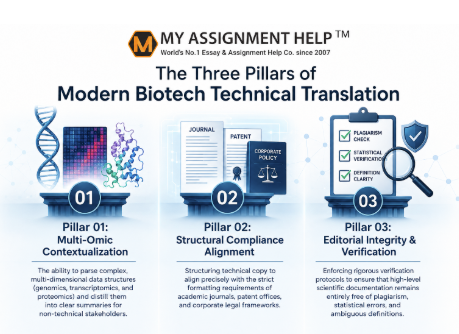
The modern technical writer in the life sciences space operates at a challenging multi-disciplinary intersection. Biology is no longer a purely descriptive field; it has become an explicitly computational science. When a firm or research institution drafts a whitepaper or study conclusion, the narrative must integrate abstract biological concepts with advanced data architectures.
| Content Focus Domain | Legacy Technical Writing Approach | Modern Specialized Writing Standard | Primary Editorial Objective |
| Genomic Therapeutics | Basic qualitative descriptions of phenotypic traits | Detailed documentation of CRISPR-Cas9 target vectors and off-target analytics | Seamless integration of sequence data with clinical safety narratives |
| Structural Proteomics | Manual diagram reviews and structural sketches | Technical descriptions of in silico molecular modeling and AlphaFold docking simulations | Translating quantitative mathematical coordinates into descriptive text |
| Epidemiological Modeling | Historical tracking tables and simple curve graphics | Clear breakdowns of stochastic disease vector formulas and spatial regression data | Converting complex mathematical models into actionable corporate briefings |
This synthesis creates a distinct operational challenge. Writers must possess the agility to seamlessly move between highly technical coding outputs and clean, accessible language. If an editorial draft is overly simplistic, it loses authority among peer-reviewed panels and regulatory reviewers; if it is excessively dense, it fails to engage corporate partners and venture capital investors. Sourcing elite writing networks that can balance these competing requirements has become a key factor in how modern biotech firms manage their market positioning.
The demands of the commercial biotech sector have caused a notable shift in how American universities structure their undergraduate and graduate life sciences programs. Historically, science education focused heavily on conceptual memorization and practical laboratory mechanics. Today, academic departments place an equal emphasis on a student’s ability to document and defend their experimental workflows.
Drafting a comprehensive, publication-ready molecular biology laboratory report or senior thesis requires an advanced understanding of structured argumentation. A student must formulate a testable hypothesis, meticulously document specialized cell-culture or filtration protocols, display complex multivariate statistical charts, and draw logical conclusions grounded in existing literature. This rigorous format leaves no room for ambiguous definitions or superficial summaries. Because students are required to balance these intensive writing requirements alongside demanding laboratory hours, the academic ecosystem has seen an increased reliance on external structural review models, professional editorial tools, and expert content advisors to meet rising institutional standards.
While elite, well-funded research universities possess the institutional infrastructure to embed dedicated technical writing labs directly within their STEM departments, the broader educational landscape is highly fragmented. Regional state universities, smaller liberal arts colleges, and community institutions frequently lack the resources to offer specialized courses that cover both advanced biological data processing and technical writing.
This educational gap creates a noticeable variance in the workforce pool. Many graduating students enter the commercial market with strong theoretical foundations but limited practical experience in drafting regulatory briefs or corporate whitepapers. To address this mismatch, forward-thinking biotech enterprises and advanced research groups are actively partnering with professional content networks and specialized editorial groups. Outsourcing structured documentation tasks to dedicated writing teams allows organizations to maintain high publication velocities while giving internal teams the space to catch up on operational workflows.
See also: Why People Are Investing in Cryptocurrency
Outsourcing allows research firms to separate discovery workflows from documentation tasks. By utilizing specialized external writing networks, companies can accelerate their publishing timelines, reduce editorial errors, and ensure that complex biological data is translated cleanly for regulatory bodies and investors.
Modern biotech writing requires an advanced understanding of data science and computational modeling. Writers can no longer simply describe physical biological processes; they must be capable of accurately interpreting and contextualizing large-scale data outputs, such as genomic sequencing runs and computational molecular structures.
Developing a strong command of technical writing requires consistent exposure to structural peer-review frameworks, precise editing standards, and formal formatting models. Many researchers utilize specialized external editorial resources, target mentorship initiatives, and follow rigorous style guides to refine their professional communication skills.
Dr. Evelyn Vance is an educational curriculum analyst and senior editorial advisor at MyAssignmentHelp, an established platform providing specialized technical documentation and professional assignment support across the United States. Sourcing insights from her Ph.D. in Molecular Biophysics, she focuses on analyzing interdisciplinary learning paths and helping upcoming professionals master the strict documentation benchmarks required by the modern bio-economy.