Newsletter Subscribe
Enter your email address below and subscribe to our newsletter
Enter your email address below and subscribe to our newsletter

 ByJohn A
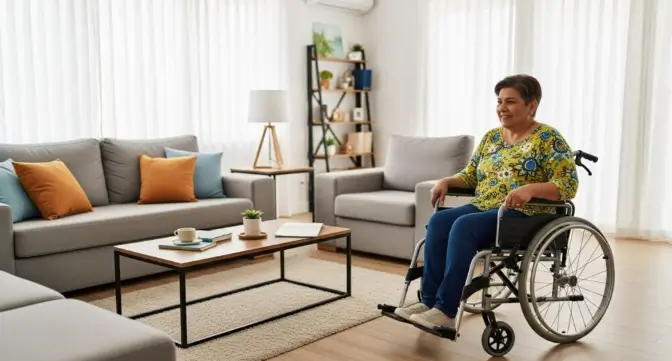
When to get furniture and when to move to Assisted Care. When does home, mean home and when does it mean care. Most of the time it is about the finer details of the furniture that you have in your home. A bad grab bar here, A low seat depth for your sofa’s and chairs. How much do your choices of furniture affect your safety and mobility when at home. We explain the key items and how they affect your independence.
What a person cannot see to be affecting their mobility could have affected their mobility in years past for good or bad. The person can either make a list and evaluate each piece of furniture and how it could affect mobility in the future or wait until the time comes and spend a lot of time and possibly a lot of money searching for pieces that will allow the needed mobility in their home.
There are three main modifications to furniture that are the most important to help people with mobility issues, enable them to carry out tasks independently, help to reduce the risk of falls and enable people to be as comfortable as possible.
For seating for people with reduced mobility, the height of the seat is an important consideration. The average seat height for furniture is around 450mm but a height of 19-21 inches (480-533mm) is more suitable for people who spend long periods of time on their furniture and have reduced mobility. Higher seats are often less comfortable for some people and can be unsuitable for taller people with longer legs.
Armrest height is important too. The armrests must be strong enough strong to hold the person’s body weight. The height of the armrests must also allow for the correct amount of leverage when sitting and standing up from the chair. This is especially important if the person uses the armrests for support when transferring in and out of the chair. Flimsy armrests can give a false sense of security and cause the person to loose their balance and fall.
Surface stability of seating. This is a critical factor when selecting any type of seating. It is worse than sitting on a beach with sand between your legs and having to balance on your seat to sit down or transfer. It is worse than sitting on a recliner that spins around and you have no idea when it is going to turn. The worst is solid, fixed furniture that does not move about whilst you are sitting on it.
Low level storage such as underbed storage that requires you to bend down to retrieve items and high level storage that requires you to stretch up to access can become more difficult to manage as time and time again as you get older and your mobility decreases. Storage at waist height is the easiest to access for people with limited mobility, meaning you can access all of your items without having to bend or stretch.
The bedroom is where most of your time is spent and so it is crucial to ensure you can move safely around the room. Bed height: when sitting on the edge of the bed your feet should be flat on the floor. A bed that is too high may require you to jump up, which can be dangerous. A bed that is low to the ground may mean you have to stand up from a seated position, which can be very strained on your joints. An adjustable bed is the ideal solution as the height can be adjusted to whatever is required.
When choosing a bed for someone with reduced mobility the height of the bed is a feature that should be taken into account. The bed should be at a height where the person can sit on the edge of the bed with their feet flat on the floor. If the bed is too high it may mean that the person has to jump down from the bed, which could cause serious injury. On the other hand, a bed that is too low could cause problems for the person trying to get up from the bed as it could put a lot of strain on their joints. An adjustable bed would be a good choice as the height of the bed can be altered to suit the user.
When choosing bedroom furniture it is essential to consider access to both sides of the bed. It is ideal to be able to access both sides of the bed from both sides but this may not be possible. If this is not possible then it is essential to consider access from at least one side. This is especially important at night when people are at their most vulnerable and may have reduced balance and be less aware of their surroundings. Reaching around from the side of the bed to access items such as clothes etc. increases the risk of falls.
Returning to the living area it is acknowledged that there are many different types of seating available to purchase. However some chairs are much better than others at facilitating people to sit down and to stand up from them. There are a number of different chairs available that have a lifting mechanism that can be lowered down to the floor to enable people to sit down. These chairs can be operated by either a switch or by manual means. Examples of these types of chairs are recliner chairs. Many people with arthritis in their legs find these types of chairs ideal for them as they reduce the strain on their leg when sitting down and also when standing up from the chair.
Coffee tables, end tables, etc. must have smooth edges so as not to cause injury should a person fall against them or on them. These tables must be of appropriate height so that items on them can be reached while seated with minimal forward lean.
See also: The Evolution of Technical Writing: Sourcing Specialized Content Expertise in the US Biotech Sector
Most furniture in the bathroom is designed with the user moving around on wet floors in mind. Thus it adds additional demands to the user’s mobility.
In many situations it is helpful to be able to bathe in a sitting position and have the support of a shower seat. These are usually provided as a fixed shower seat which is mounted on the wall and folded down when not in use. There are also freestanding models which can be used in a number of bathrooms and moved from room to room.
Toilet seats – a simple bit of furniture, but important to us all for our comfort and safety. The height of the toilet seat is often not given a second thought, but using a raised toilet seat or a comfort height toilet could make a big difference in alleviating some of the strain of going to the loo.
Start with the pieces of furniture that you use most frequently – this will be the seating in your main living area, and then your bed(s) or other furniture that you use for resting. Work your way through your home item by item, replacing the furniture with the greatest impact on your daily activities and your independence first.
Start with the furniture that you use most within your home. As mentioned previously, this will be your seating in your living areas, followed by your bed and then proceed to the other rooms in your home. Don’t try to purchase all of the new furniture at once as this can be very quickly become very expensive. It may also lead to you purchasing some items that you don’t need.
Measure out the room, and more importantly the furniture itself, when purchasing to compare against the manufacturer’s standard sizes. Often there are big variances, and just two inches in the seat height of a chair can mean the difference between you being able to use it independently and needing help.
Incorporating future needs into furniture choices: People’s mobility declines gradually. Therefore, even furniture that is just right for you today could, in a few months’ time, no longer be suitable for you. Furniture that can be altered, to meet your changing needs, could save you a lot of money in the long run, even though they may be more expensive at the start.
Don’t have to throw away all of the furniture you currently have. Use furniture risers to bring the arm rests up on the arm chairs and the arms of the sofa. Use firm cushions on the seats and the back of the chairs and sofa to raise the height and support yourself when sitting.
Armrest covers with grip can be placed on armrests already on your furniture to increase the grip of the armrest to assist in standing up. Professional occupational therapy assessments can identify specific needs of a person and recommend the best solution to assist in daily activities. It may be simple modifications to the current furniture to increase function and safety and to manage costs.